Five Things That Turn a Wake Jump Into a Belly Flop — and How to Test Each One

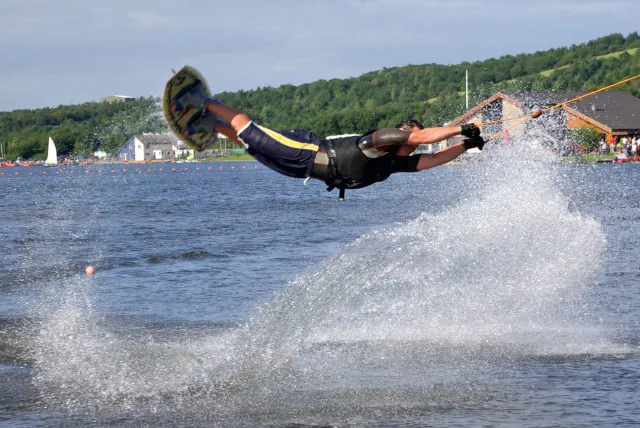
Photo: wakeboarder mid air wake jump spray side view, via a57.foxnews.com
You take the edge, you feel the speed build, you leave the wake, and then the water comes up and introduces itself to your ribs. Or the board stalls halfway and you land on your backside. Or you get airborne for a gloriously brief moment and the handle ends up somewhere near your hip, pulling you sideways into a shape no physio would endorse.
The instinct is to fix the landing, because that's the bit that hurts. That's almost always the wrong end of the problem. Jump faults cascade: a poor approach edge creates slack line, slack line makes your pop late, late pop forces a desperate reach for the handle, and the handle position ruins the landing. Fix the top of the chain and three problems vanish at once.
So work the list in order. Stop at the first thing that's clearly wrong, fix it, then start again.
Before you diagnose anything: film two laps
You cannot feel what your body is doing at the moment of take-off — nobody can, the whole thing lasts about a third of a second. Get someone to film two consecutive jumps from the side, on a phone, at normal speed. Side-on is the money angle: it shows your edge, your pop, and your handle position all at once.
The 'your phone is the cheapest coach you'll ever hire' approach applies double here. Watch the footage on the drive home, not on the dock, so you're not tempted to change five things in one session.
Check one: the approach edge
What it looks like. A hard, sudden edge that dumps speed, or the opposite — riding almost flat and hoping.
What it feels like. Either a violent jerk as the line comes tight, or a soft, floaty take-off with no real height.
The self-check. Look at the spray off your board in the two seconds before take-off. It should be a clean, building wall, getting steeper and higher as you go. If it's a sudden explosion, you slammed the edge on. If there's barely any spray, you never loaded anything.
The drill. Ride three passes without jumping at all, just carving a wide, smooth arc towards the wake and letting off as you arrive. The word to keep in your head is progressive. Build, don't smash.
Check two: line tension
What it looks like. Slack in the rope or cable right before the wake. Your arms reaching forward to find it again.
What it feels like. Nothing pulling. A vague sense that the boat or cable has forgotten about you.
The self-check. At the moment your board touches the wake, the line should already be tight and slightly behind you. If you can see daylight between your hands and any slack, you've lost it.
The drill. On cable, this usually means your cut was too narrow. Go wider, and start your turn back in earlier than feels natural. On a boat, it more often means the driver is running a long line or a slower speed than you need — a conversation worth having rather than a technique worth grinding.
Check three: pop timing
What it looks like. Your knees bending after the wake rather than through it. Or standing up fully before you've left the water.
What it feels like. A dull thud instead of a spring, or a jump that peaks a metre too early and then dies.
The self-check. Slow the footage down frame by frame. You want to see your legs extending as the board rides up the wake face, with the extension finishing roughly at the lip. If you're fully extended before the wake, you're early. If you're still absorbing as you pass the lip, you're late.
The drill. Cut in and simply ride over the wake without jumping, but count out loud 'one' as your board hits the trough and 'two' as it reaches the crest. Then try to finish your leg extension on 'two'. It's a slow, unglamorous drill and it works.
Check four: handle position
What it looks like. Arms fully extended above your head, or the handle drifting down to your waist, or — the classic — one hand letting go.
What it feels like. Being pulled forward over the nose, or spun sideways without meaning to.
The self-check. At the peak of the jump, the handle should sit around hip to lower-rib height, with your arms bent and close to your body. Handle at the chest, elbows in: that's the position. If you can see your own elbows pointing outwards, you're reaching.
The drill. Do five wake jumps where you deliberately keep both hands on and both elbows bent, and don't attempt any height at all. Accept that they'll be small. You're training the position, not the trick.
Check five: landing posture
What it looks like. Straight legs, locked knees, weight back. Or the board landing nose-first because you looked at the water.
What it feels like. A butt check, a nose-dive, or a slap that travels up your spine.
The self-check. You want to land with soft knees, weight centred over the board, and your eyes on the far bank rather than down at your feet. Landing with straight legs on a wake jump is the equivalent of jumping off a wall and locking your knees — technically possible, deeply unwise.
The drill. Practise the landing separately. Ride over the wake with a tiny hop, land, and absorb it deliberately, letting your knees bend to about 90 degrees before you stand back up. Ten of those is worth more than ten failed full jumps.
The order of operations
Check them in sequence, one per session, and resist the urge to tinker. Edge first, because everything downstream depends on it. Then tension, then pop, then handle, then landing. If you fix the handle before the edge, the good handle position won't hold for more than a jump or two.
Two UK-specific wrinkles
Cold water changes how this feels. In a thick winter suit with 5mm boots, you lose board feel and your ankles stiffen up, which makes the progressive edge harder to judge. Cut yourself some slack between November and March — a jump that feels crisp in a shorty will feel mushy in a hood and gloves, and that's the kit, not you.
Wind matters too. A crosswind at the corner of a cable lake will push you off your line before you've even started the approach, so if your edge suddenly feels wrong on a gusty day, blame the weather rather than rebuilding your technique. Check the forecast before you drive over.
And if you're squeezing in a session after work, do the drill first. Cold, tired and rushing is how bad habits get baked in for the whole season.
What to do with the results
Write down your one fault on your phone before you leave the car park. Next session, that's the only thing you work on. One change per session, filmed, is how riders go from slapping the water in April to clearing the wake cleanly by June — and it's a considerably less painful route than trying to fix everything at once.