Load the Line, Not the Pressure: The Cable Park Vocabulary Nobody Hands You at Check-In
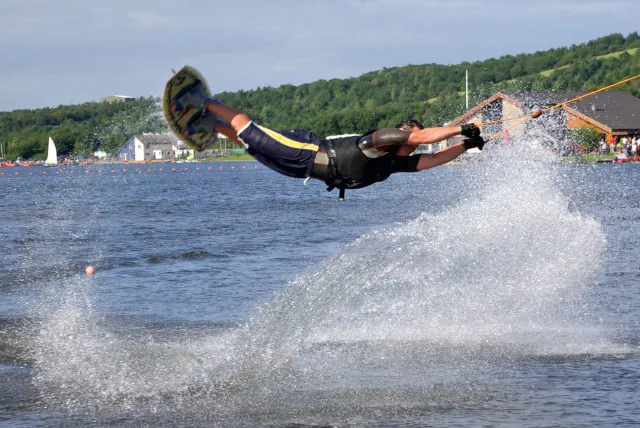
Photo: Stephen McKay, CC BY-SA 2.0, via Wikimedia Commons
Stand in the queue at a UK cable park on a Saturday morning and you'll hear a language that's almost English. Someone on the dock is yelling about loading a line. A teenager in a damp wetsuit is swearing blind that the corner ate him. A bloke in the hire shed is asking whether you want fins in. Nobody stops to explain any of it, because everyone already knows — and you're stood there nodding like a person who definitely understands.
Here's the glossary I'd have wanted taped to the check-in desk. Twenty-seven terms, grouped roughly in the order you'll meet them, with a note on when each one lands and what to say if you're lost.
At the desk and in the hire shed
1. Cable. The overhead motorised system that tows you round the lake. Most UK parks run one direction, a few switch it. If someone says 'the cable's down', they mean the motor has stopped, not that the rope has snapped.
2. Straight-line cable. A two-tower setup, so you ride out and back in a straight line rather than a loop. Often the friendlier option for a first go, because you get a proper rest between pulls.
3. Operator. The person in the tower running the motor. They control your speed. If you want it slower, ask — they would far rather you said something than spent twenty minutes being dragged round at a speed you can't handle.
4. Rotation. Your turn in the queue. On a busy Saturday you get a slot of a few laps, then you rejoin the back of the line. It sounds technical; it just means wait your go.
5. Hire kit. Board, boots, helmet, buoyancy aid. Ask specifically about boot fit. Loose boots are the quickest route to a rolled ankle, and staff will happily swap them.
6. Buoyancy aid. At a cable park this usually means an impact vest rather than a life jacket. It's a requirement at most UK sites and it makes the inevitable crashes considerably less unpleasant.
7. Regular / goofy. Which foot goes forward. Regular is left foot forward, goofy is right. Roughly two-thirds of riders are regular and absolutely nobody cares which you turn out to be.
8. Duck stance. Board set up with both feet angled outwards, like a duck's. Standard for cable, because you'll spend half your life riding switch and need to be comfortable both ways.
Stance and edges
9. Heelside / toeside. Which edge of the board is digging in. Heelside means pressure through your heels, toeside through your toes. You will hear this constantly — 'go toeside into the corner' — and it's the single most useful piece of language to pick up early.
10. Load the line. Pull against the cable so the rope goes tight and stores energy. Load too gently and you'll never build speed; load too hard and you'll get yanked off your feet. Expect to hear it shouted at you from the dock within the first minute.
11. Progressive edge. Building your edge gradually rather than slamming it on. This is the phrase that separates beginners from improvers. Progressive edge gives you speed and pop; a sudden edge gives you a face full of water.
12. Cut or carve. Riding across the cable at an angle to build speed. 'Take a cut out wide' means ride away from the middle before turning back in.
13. Tension. How tight the line is. Most beginners ride with it slack and wonder why nothing works. The fix is a wider cut and a smoother load, not a harder pull.
The handle, the pull and the start
14. Handle (or bar). The thing you hold. At a cable park it hangs from the carrier and swings back round to you after each lap, which is why you'll see people ducking.
15. Ready position. Knees bent, arms in, board in front of you, weight centred. Dock staff will say it forty times a day. It's the whole trick, honestly.
16. Beach start. Feet on the dock or slipway, board in the water, cable lifts you as it engages. Most UK parks start beginners this way because it's far less faff than swimming out.
17. Deep-water start. You're already floating when the cable engages. Harder to time, and noticeably colder in March, but it's what boat riders are used to.
18. Pull-out or pick-up. The moment the operator engages the motor and takes up the slack. If you hear 'here comes the pull', get into the ready position and stop chatting.
The obstacles
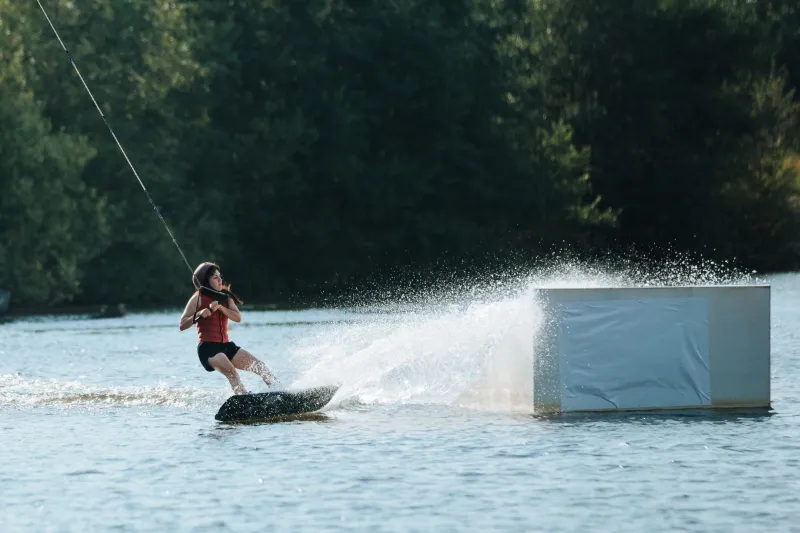
19. Kicker. A ramp, usually floating, that launches you upwards. They come in a range of sizes and the small one is smaller than you think. Start there.
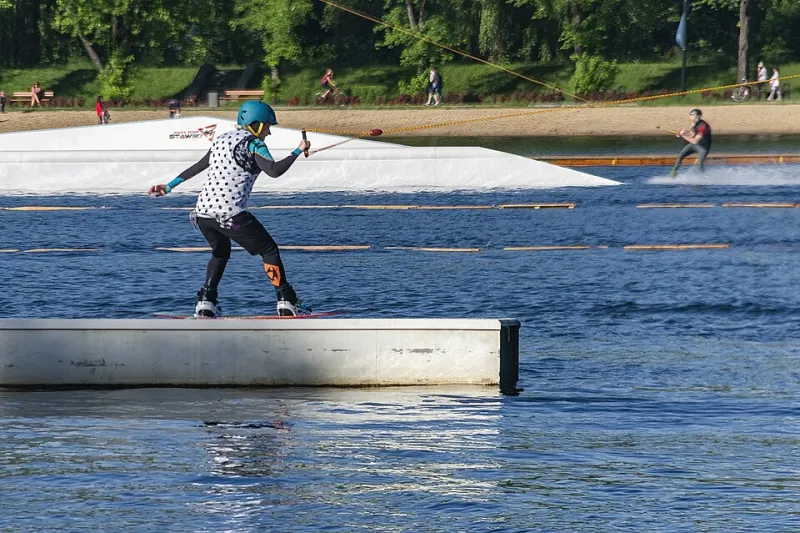
20. Slider, box or rail. The things you ride along. Sliders are plastic, boxes are wooden, rails are metal. Begin on a box — it's wider and much more forgiving.
21. Feature. The catch-all word for anything that isn't flat water. 'What features have you got?' is a perfectly normal question to ask at check-in.
22. Corner. The turn at each end where the cable changes direction and swings you round. Corner technique is its own skill and everyone bails there in their first month. Everyone.
23. Wake-to-wake. Clearing the whole width of the wake in one jump, rather than landing on top of it. On a boat this is the milestone everyone chases; on cable it's more of a training habit.
Trick talk
24. Switch. Riding with your non-natural foot forward. Cable riders pick it up fast, because the corners force you round anyway.
25. Blind. Riding or landing with your back to the cable, so you can't see where you're going. Sounds horrifying, is manageable on a small kicker.
26. Handle pass. Passing the handle from one hand to the other, usually mid-spin. The gateway skill to essentially every spin you'll ever learn.
27. Grab. Grabbing the board mid-air. The names come from skate and snowboarding — indy, melon, stalefish — and riders shout them at each other as encouragement. Nobody expects you to know them yet.
Four more you'll hear within the first hour
Not on the list, but they'll come up. Bail is any unplanned exit, voluntary or not. Butt check is a landing that ends on your backside. Slap is the flat, unglamorous sound of a jump gone wrong. Sesh is a session, and 'good sesh' is the standard sign-off in the car park.
The bit nobody says out loud
Every single person on that water learned these words by hearing them and guessing. The confidence gap isn't about ability, it's about vocabulary, and vocabulary takes about one session to fix.
So ask. Ask the operator to slow the cable down. Ask the hire shed to check your boots. Ask the instructor whether they'll watch your next lap and tell you one thing to change — that request lands far better than a vague 'any tips?'. Ask a fellow rider what a word means while you're both queuing, because people at cable parks are, almost without exception, chuffed to be asked.
The one thing worth not doing is asking a rider for coaching the moment they come off the water. Give them thirty seconds to breathe first.
The short version
Learn heelside, toeside, load the line and progressive edge, and you can follow about eighty per cent of a beginner session. Everything else arrives on its own, usually while you're lying face down in the lake wondering what a blind landing was supposed to feel like.