The Queue Is Part of the Lesson: Cable Park Rehearsal for Sharper Jumps
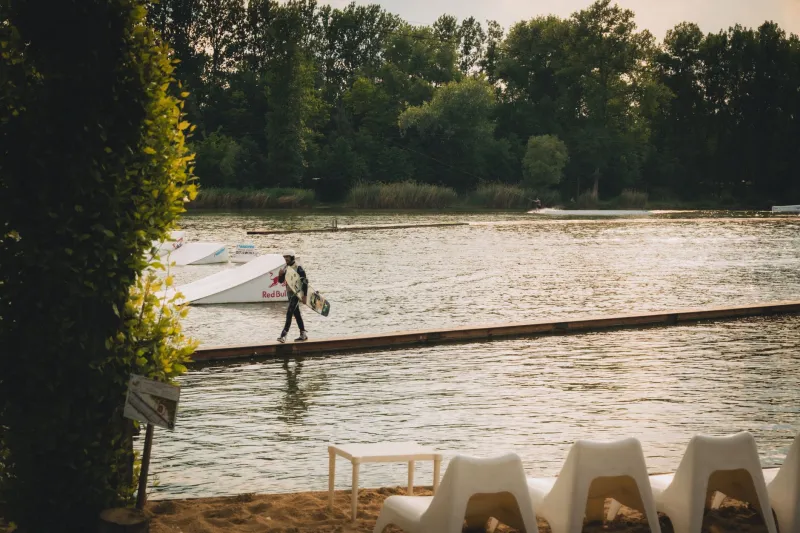
A busy Saturday at a UK cable park has its own rhythm. You queue, you shuffle forward, you watch the same corner get attacked by riders of wildly different abilities, and then suddenly it is your turn and your brain has gone blank. Most of us treat that wait as dead time — something to endure while the person in front has another go. But the queue is not a waiting room. It is a free coaching session, if you know what to look at.
This is not about turning every visit into a bootcamp. It is about using the ten or fifteen minutes you already spend standing there to make the next set feel less like a surprise. No extra water time, no new kit, no drills that make you look strange in front of the park staff. Just a few small habits that turn watching into rehearsal.
Dead Time Is Not Dead
When you are next in line, your body is idle but your brain is still working. The problem is that it usually works on the wrong things: worrying about the jump you fluffed last week, half-listening to someone else’s advice, or trying to remember whether you were meant to load the line earlier or later. That is noise. The queue gives you a chance to replace it with one clear picture.
Think of it as a warm-up for your attention. You are not trying to analyse every rider who passes. You are trying to notice the things that will actually matter when the handle is in your hands: how the line goes tight, how an edge holds, and what a clean landing looks like from the bank. That is the whole job.
Watch the Line, Not the Trick
It is tempting to watch the jump itself. The big air, the grab, the spray. But at beginner and intermediate level, the jump is usually the last thing to go right, not the first. The useful information is earlier in the sequence.
Pick a rider and watch the line between the handle and the cable. Does it go slack before they load? Does it snap tight too early? Do they get pulled off edge before they have finished their approach? You do not need to diagnose their whole technique. Just notice the moment the line changes. Then watch your own set later and see if you can feel the same thing happening to you.
Edge control is the other half. Look at the board’s angle as the rider approaches the kicker or the wake. Are they still holding an edge, or have they stood up and flattened out? A lot of UK cable riders who struggle with jumps are not failing at the take-off. They are arriving at it with a board that has already given up. Watching that from the bank is much easier than feeling it at speed.
Pick One Cue Before the Dock
By the time you reach the front of the queue, you should have one cue in your head. Not three. One.
It might be “wait for the line”, “hold the edge”, “look at the landing”, or “stand tall at the top”. The wording does not matter as much as the fact that it is short enough to survive the walk to the dock. If your cue needs a paragraph, it is not a cue. It is a plan, and plans fall apart when you are nervous.
Choose it while you are still in the queue, not while you are clipping in. Watch a rider who is roughly at your level and borrow a single idea from what you see. If they get pulled off edge early, make your cue about holding yours. If they rush the take-off, make your cue about waiting. You are not copying their jump. You are using their set to sharpen your own focus.
The Three-Rider Scan
If you want a simple routine, try this. While you wait, watch three riders in a row. Not closely enough to be weird, just enough to notice one thing each.
For rider one, watch the line tension. For rider two, watch the edge into the feature. For rider three, watch the landing and the first two seconds after it. That is it. Three riders, three things. It takes less time than scrolling your phone and it gives your brain something useful to hold on to.
You will be surprised how often the same problem shows up across all three. Maybe most riders are dropping their edge before the kicker. Maybe the ones who land well are the ones who keep their eyes up. That pattern is your session’s theme, and you found it without leaving the bank.
Make It Social, Not Stalky
There is a fine line between observation and staring. Keep it friendly. If you are watching someone’s set, a quick nod or a “nice one” when they come back round is enough. You do not need to offer feedback unless they ask. The point is not to become the self-appointed coach of the queue. The point is to borrow a bit of focus.
It also helps to chat about what you saw. A simple “your edge looked really solid into that kicker” is a nice thing to say, and it reinforces the thing you are trying to learn. You will remember it better because you said it out loud. Just do not turn it into a full technical debrief while they are trying to get their breath back.
What to Ignore
Not everything in the queue is useful. Ignore the rider who is trying to go bigger than everyone else on every pass. Ignore the person who tells you to “just send it” when you have not yet worked out how to hold an edge. Ignore the temptation to compare yourself to the teenager who has been riding since they could walk.
You are looking for repeatable information: line tension, edge control, landing posture. Those are the things that transfer from one rider to another. The rest is noise, and there is plenty of it at a busy park on a sunny weekend.
Bring It Back to Your Set
When you finally get on the water, you will have one cue and one or two observations. That is enough. Do not try to fix everything at once. Ride your set, feel for the thing you noticed from the bank, and then let it go. The queue will be there again next time.
The best jumpers at UK cable parks are not always the ones who get the most water time. They are often the ones who use the time around their sets well. The queue is part of the lesson. Treat it that way, and your next jump will feel a little less like guesswork and a little more like something you already knew was coming.