Boat Wake, Different Animal: Five Fixes for Cable-Trained Riders
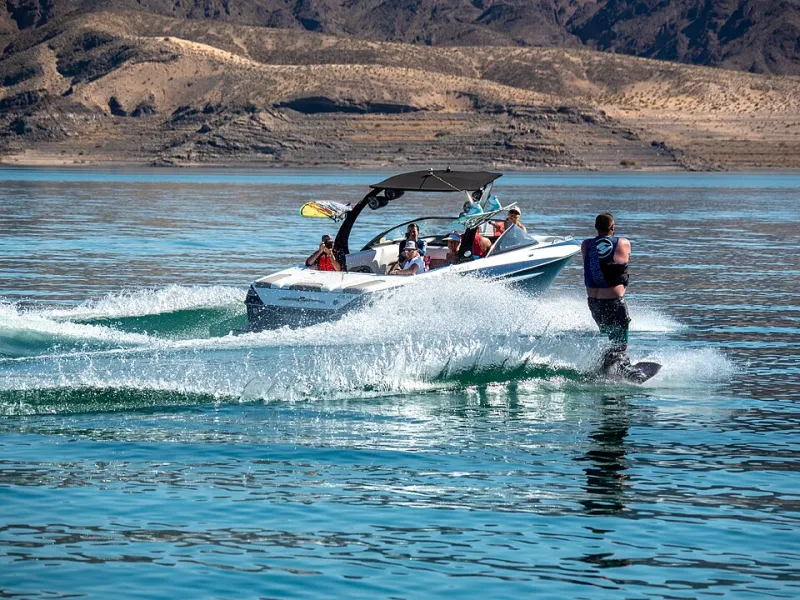
Photo: Andrew Cattoir (Lake Mead National Recreation Area), Public domain, via Wikimedia Commons
You can spend a whole summer at a British cable park, clearing every kicker with a tidy little pop, and still climb into a boat for the first time feeling like you have never seen a wakeboard. That is normal. Cable and boat are the same sport in the same way that a spin class and a hill climb are both cycling: related, useful, but not interchangeable. The pull is different, the wake is different, and the timing that made you look competent at the cable park can suddenly feel half a beat late.
The good news is that you do not need to start again. You need to adjust five habits. Treat these as translation work rather than a reset, and your first boat set will feel like progress instead of a step backwards.
1. Relearn what rope tension feels like
At the cable, the line pulls you at a steady speed. Behind a boat, the pull arrives in surges. The driver accelerates, the rope goes tight, then softens as you swing about. Cable-trained riders often keep reaching for that constant tension, which leaves them stretched out and off balance when the boat surges.
Keep the handle closer to your lead hip and let your elbows stay soft. You are not trying to win a tug-of-war with the boat. You are trying to stay stacked over your feet so the line can load you without pulling you onto your front foot.
Drill: the tension pass. Take one pass with no jumps at all. Ride outside the wake, edge in gently and pay attention to where the rope goes tight and where it goes light. At the trough, let the handle come towards your hip instead of pulling it with your arms. Repeat until you can feel the load arrive without snatching at it.
2. Swap the locked edge for a building edge
A cable kicker rewards a committed edge. You set it early and hold it. A boat wake works better with an edge that builds. Think of a volume dial rather than a light switch: easy at the start, firmer through the middle, strongest as you approach the whitewash.
Cable riders who keep a locked edge all the way in often arrive at the wake too flat or too angled, and the pop goes sideways rather than up. The fix is not to edge harder. It is to edge progressively.
Drill: the three-count edge. Start well outside the wake. Count one as you begin the edge, two as you pick up pressure, and three as you reach the wake. Do not jump on the first few passes. Just feel the edge build and notice how the board releases when you stand tall at the crest.
3. Look beyond the lip, not at it
At the cable park, the obstacle is right in front of you, so it makes sense to look at it. Behind a boat, staring at the wake lip is a quick way to round your shoulders, drop your hips and turn a jump into a vague sideways hop.
Pick a fixed point on the shore, a tree, a chimney, a moored dinghy, anything that gives your eyes somewhere to go. Keep your gaze there through the approach. This keeps your chest up and your body moving across the wake rather than down into it.
Drill: the fixed-eye pass. Choose your shore target before the driver pulls you up. Take two wake crossings without jumping, keeping your eyes on that target the whole time. Then add a small jump on the third crossing, still looking at the target rather than down at your board.
4. Let the wake do the lifting
Cable kickers pop immediately. You hit the ramp, the ramp sends you up, and you are in the air before you have much time to think. A boat wake is slower. The pop comes from extending your legs at the crest, not from jumping earlier and harder.
Cable-trained riders often try to jump at the wake and end up absorbing the shape of it instead. The boat is not a kicker. It is a moving ramp that needs you to stand tall at the right moment.
Drill: the stand-tall crossing. Approach the wake with your three-count edge and simply stand tall as you reach the crest. No grab, no big jump, no extra effort. Let the wake lift you. Once that feels stable, add a small pop on the next pass. You are looking for timing, not height.
5. Put the handle where your hips can follow
Handle position is the quiet difference between cable and boat. At the cable park, you can get away with holding the handle out in front or letting it drift. Behind a boat, a handle that stays close to your lead hip keeps your hips underneath you and makes the wake jump feel much less effortful.
Think of the handle as a guide for your hips, not a steering wheel. If your arms are straight and the handle is far away, your hips will lag behind. If the handle is close and low, your body can move with the boat rather than against it.
Drill: the hip-pocket pass. Ride with the handle close to your lead hip and your arms bent. Make three small wake jumps without worrying about height. Ask someone in the boat to watch whether the handle drifts away from your hip on the approach. If it does, bring it back before you add speed or size.
Give the first boat set a job
A first boat set is not the place to fix everything at once. Pick one adjustment, run the drill for a few passes, then stop thinking about it. UK boat time is often limited by weather, light and who has the keys to the club boat, so it pays to arrive with a plan rather than a vague hope of going bigger.
It also helps to talk to the driver before you get in. Ask for a steady pull, agree a speed you are comfortable with and keep the first set short. A reservoir in the Midlands or a Scottish loch on a breezy afternoon will not always give you the flat water of a cable park, and that is fine. You are learning to read a different kind of wake.
The cable park taught you how to hold an edge, land a jump and take a fall. The boat will teach you how to wait, build and extend. Those are not beginner skills. They are the next layer of your riding, and they will make every cable session better too.