Look Back Before You Load: Cable Park Traffic Sense for UK Beginners
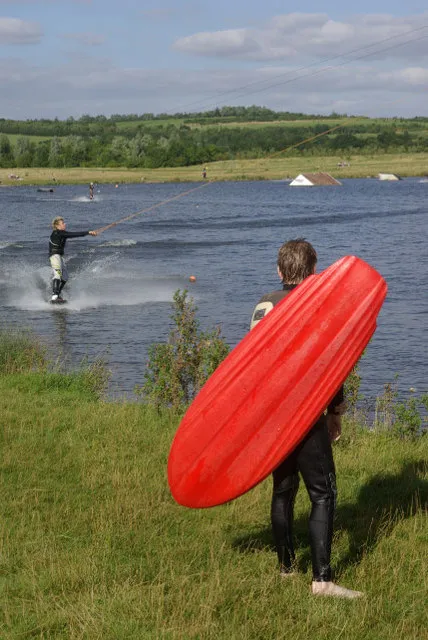
Photo: Stephen McKay, CC BY-SA 2.0, via Wikimedia Commons
There is a moment in every new cable rider's life when the lake stops feeling like a lesson and starts feeling like a motorway. You are cruising down the far straight, comfortably in your own little world, and then you hear it: the faint zip-and-hum of someone much quicker coming up behind you. Your brain says do something. Your body, unfortunately, chooses freeze.
That is the passing lane problem. Most UK cable parks run beginner sessions, coached blocks and open sessions, but the traffic code between riders is rarely written down. It gets passed along in nods, hand gestures and the occasional apologetic shout across the water. If you have never been taught it, a full lake can feel chaotic. It isn't. It just has rules — quiet ones.
The cable is not a road, but it has lanes
Forget lane markings. On a cable lake, the lane is a shape. It is the arc you take from one corner to the next, and it changes depending on whether you are heading into an obstacle, setting up for a jump or simply staying out of the way.
The simplest way to think about it: there is a working line and there is a waiting line. The working line is where riders are loading the cable, carving toward a kicker or lining up a feature. The waiting line is the wider, calmer water outside it. Beginners belong in the waiting line until they are ready to commit. Faster riders use the working line to keep speed and rhythm.
If you are not sure which one you are in, look at your edge. If you are on a hard, purposeful carve toward something, you are in the working line. If you are drifting along on a flat base, you are probably in the way. Not a crime — just a fact.
When someone catches you up
This is the big one. A faster rider appears behind you. What now?
First: hold your line. Do not panic-turn, do not slam on the brakes by throwing a huge edge, and do not suddenly swing out wide. Predictability is the whole game. A quicker rider can read a steady line from a long way back. What they cannot read is a rider who changes direction every two seconds like a startled pigeon.
Second: check your shoulder before any move. A quick glance over your leading shoulder tells you where they are and which side they are likely to pass. If they are already committed to the outside, stay inside. If they are lining up a feature, give them the water. It costs you half a second and saves everyone a hospital story.
Third: if you need to stop or slow down, do it deliberately. Raise a flat palm — no wild waving — and ease out to the widest, quietest part of the lake. Do not stop dead in the middle of the straight. Do not stop just after a corner where nobody can see you until it is too late.
The obstacle queue is a real queue
At a busy UK park, the water before a kicker or a slider is not a free-for-all. It is a queue with no rope. The etiquette is simple: if someone is already setting up for the feature, let them have it. Do not sneak up the inside at the last second. Do not sit bobbing about directly in the approach. Either commit or move wide.
If you are waiting, wait wide and wait still. A rider coming in hot needs a clear picture of the approach. Your board wobbling about in the middle of it is the equivalent of standing in a shop doorway.
And if you are the slower rider being caught by a whole train of quicker riders? Pick your moment, pull wide, let them through, then rejoin. Nobody minds a beginner who is easy to read. Everybody minds a beginner who is impossible to pass.
Signals beat shouting
Shouting across a lake is useless. The water swallows it, the wind steals it and nobody hears anything except the cable motor. Signals work because they are visual and quick.
A raised flat palm means I am slowing or stopping. A point toward the water you intend to take means I am going that way. A pat on the head — the classic cable signal — means I am done, coming in or stop, depending on context. Keep them big and early. A signal at the last second is not a signal; it is a surprise.
If you are the faster rider, use the same language in reverse. Give a wide berth, do not buzz a beginner's edge just because you can, and save the aggressive overtake for open water. The best riders at any UK cable park are the ones you barely notice passing you.
Three glances that solve most of it
Before you load onto the water, glance at the lake. Who is where? Who is fast? Who is wobbling?
Before you commit to a feature, glance over your shoulder. Is someone already in the approach?
Before you pull out wide to stop, glance again. Are you about to cut across someone's line?
That is it. Three glances and a bit of common courtesy. The passing lane problem is not really about speed. It is about being readable, leaving room and remembering that everyone on the water paid to be there — including the rider who is currently trying to get past you.