The Corner Is a Trick Too: Cable Park Turning for Riders Who Are Tired of Drifting

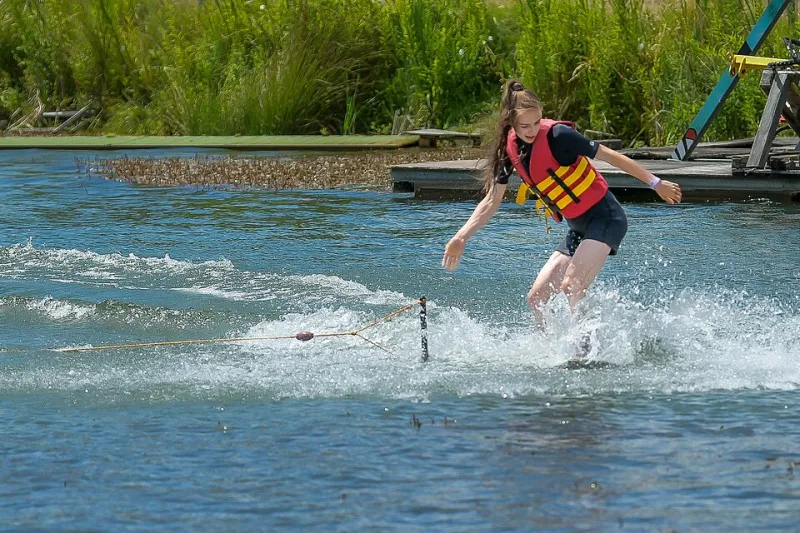
Photo: wakeboarder carving a turn at a cable park corner, via cyberguy.com
Most cable beginners think of a lap as features separated by straight bits. The features get the attention. The corners get survived. You drift wide, the handle pulls, you scramble back into line, and by the time the next kicker arrives you are still recovering from the turn. That is not a fitness problem or a bravery problem. It is a technique gap. At a UK cable park, the corner is one of the few things you practise on every single lap, whether you mean to or not. So you may as well mean to.
Why corners feel harder than they look
A cable park corner is not a gentle bend in a tow rope. The cable is continuously moving, the carrier is tracking around a pulley, and your body is trying to hold an edge while the direction of pull changes. If you stand there like a passenger, the cable decides where you go. Usually that means wide, off-balance and slightly out of control.
Riders who look calm through the corners are not fighting the cable. They are negotiating with it. They arrive with a plan, keep the handle close, and exit with enough control to set up the next feature. That is the whole game. The corner is not a pause between tricks. It is a transition, and transitions are where smooth riders are made.
The corner as a four-part sequence
It helps to stop thinking of the turn as one big event. Break it into four small jobs.
1. The early edge-out
Start your edge before the corner is right in front of you. A common beginner mistake is waiting until the buoy is almost alongside, then leaning away in a panic. By then the cable has already chosen your line. Begin with a gentle edge outwards a few metres earlier than feels necessary. You are not trying to carve a dramatic arc. You are simply creating space and time. Look through the turn, not at the buoy.
2. The handle through the turn
Keep the handle close to your body, roughly around hip height, and let your chest stay open to the direction of travel. If your arms extend, the cable wins the argument. If the handle drifts away from your hip, your edge gets weak and the board starts tracking wherever the pull takes it. Think of the handle as something you are carrying, not something you are clinging to. Small adjustments are fine. A death grip is not.
3. The speed check on exit
As you come out of the corner, flatten the board slightly and stand tall. Beginners often over-edge on exit because they are still trying to lean away from the pull. That loads the line, accelerates the board and sends them wide or off balance. A quiet exit is a fast exit in the long run. Let the cable settle, regain your stack, then decide what comes next.
4. Setting up the next feature
This is the part nobody mentions at check-in. A good corner does not just deliver you to the next straight; it puts you in the right place for the next obstacle. If you exit wide, you may need to edge in early. If you exit narrow, you may need to give yourself room. The corner is your preparation window. Use it instead of enduring it.
The rule: hold your line or give the cable room
Here is a simple decision that works for most UK cable beginners. If the cable is taut, your handle is close and you feel balanced, hold your line through the first half of the turn. If the handle is pulling you out of shape, your arms are straightening or the line goes slack, give the cable room. Ease your edge, let the turn take you slightly wider and reset. Fighting a corner you have already lost is how riders end up in the water or halfway up the bank.
Giving room is not failure. It is a speed check with better manners. As you improve, you will hold your line for longer and give room less often. But early on, erring towards room is almost always the smarter choice.
Two drills worth doing
Dry land: the handle-and-hip walk
Stand in a athletic stance with a broom handle or a resistance band held at hip height. Imagine a corner curving to your left. Step through the turn slowly, keeping the handle close to your hip and your chest facing the direction you are travelling. Do ten steps one way, ten the other. It looks ridiculous. It also teaches your body what handle position should feel like before you add water, speed and a queue of people watching.
On water: the wide-entry, quiet-exit lap
Pick one corner at your park and commit to three focused laps. On each lap, start your edge-out earlier than usual, keep the handle close through the turn, and flatten the board deliberately on exit. Do not worry about the features. You are not there to jump. You are there to make the corner boring. Once it feels boring, add the next feature back in and notice how much more room you have.
When it goes wrong
If you lose the handle, do not grab at the air. Keep your arms in, look at the handle and let the cable bring it back to you if possible. If you drift wide, ask yourself whether you started your edge early enough. If you get yanked off line on exit, you probably held too much edge for too long. These are not random failures. They are feedback.
A quick word for UK conditions
British cable parks are often busy, the water is sometimes cold, and the corners can become bottlenecks. That makes corner etiquette part of the skill. If you are giving the cable room, check behind you before you drift wide. If someone is already in the corner, do not try to out-edge them into the same space. A calm turn is easier when everyone knows where they are going.
The corner is free practice
Every lap gives you at least two corners. That is free repetition, whether you are working on wake jumps, grabs or just staying upright. Treat the turn as a trick in its own right and the rest of the lap gets easier. Hold your line when you can. Give the cable room when you need to. And stop being a passenger in the one part of the park you visit every single lap.