Before You Grab the Handle: The Wordless Signals That Keep a First Cable Session Smooth
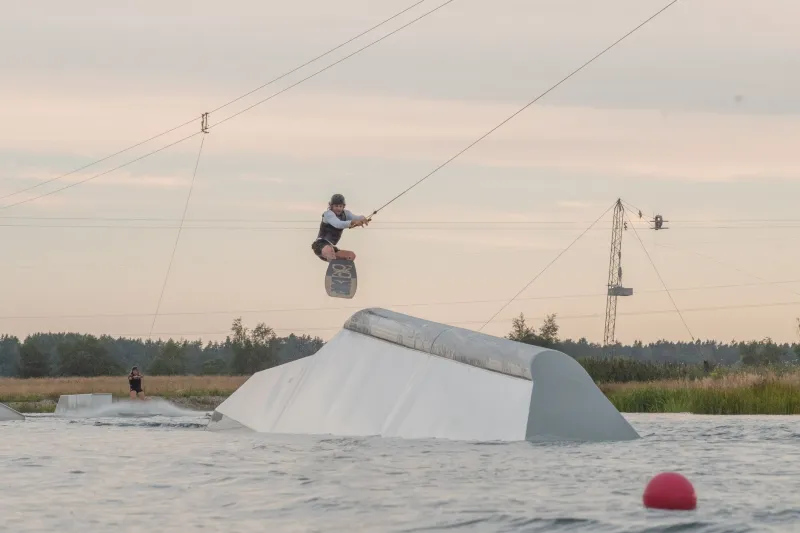
Walk into a UK cable park for the first time and the thing that surprises most people isn't the speed of the cable or the size of the jumps. It's the silence. Or rather, the fact that nobody seems to be shouting instructions. Riders glide past, operators stand in a tower, someone on the dock raises a hand, and somehow everyone knows what's happening.
That's because a cable park runs on gestures. From the moment you step onto the dock to the moment you hand back your hire board, you're taking part in a quiet back-and-forth that keeps the whole place moving. Learn a handful of those signals before your first pull and you'll spend less time guessing and more time riding.
Why the cable park speaks in hand signals
A cable tower sits 30 or 40 metres from the dock, the cable itself is running overhead, and the water is noisy. Shouting across that gap is pointless. Add in the fact that an operator is often managing several riders at once and you can see why the system is visual.
The other reason is safety. If you fall in the middle of the lake, the operator needs to know within a couple of seconds whether you're fine or whether the cable should stop. A thumbs up or a tap on the head does that job far faster than a shout that gets swallowed by the wind.
So the signals aren't decoration. They're the vocabulary of the park. And like any vocabulary, it's easier to learn before you need it.
The five signals you'll actually use on day one
Every park has its own dialect, and the briefing you get at check-in is the final word. But most UK cable parks, from Sheffield Cable Waterski to Box End Park in Bedfordshire, use a version of the same core set.
Thumbs up. This is the universal "I'm ready" and "I'm fine". You'll use it on the dock to tell the operator you want the pull, and again after a fall to confirm you're not hurt. It's the signal you'll give more than any other.
Raised flat hand, palm out. Think of it as a polite stop sign. It means hold, wait, or I'm coming in. Use it if you need a moment on the dock, if you've had enough and want the operator to slow the cable, or if you're swimming to the side and want to make sure you've been seen.
A tap on the top of your head or helmet. This is the one that trips up beginners. At most parks it means "I'm okay after that fall" — a quick way of telling the operator not to stop the cable for you. At a few parks it means the opposite, so confirm it in the briefing. Either way, it's a signal you'll see a lot.
Arm across the throat, or a hand chopping across your body. This is a cut signal. It means stop, I'm done, or kill the speed. You'll use it at the end of your set when you want the operator to bring the cable to a halt so you can exit the water.
Pointing down at the water or at yourself. A simple way of saying "I'm falling" or "I'm still here". Useful if you're bobbing about in the middle of the lake and want to make sure you've been clocked.
The calls you'll hear — and what to shout back
There's a spoken layer too, and it's worth knowing the basics. On the dock you'll hear "rider ready?" before your pull. The answer is a clear "ready" plus a thumbs up. You may hear an operator call "dropping" when they release the handle, or "coming in" when a rider is heading for the dock.
Shore crews often call "next rider" when it's your turn to step forward. If you're not sure, ask. Nobody minds a beginner who checks. Plenty of experienced riders still ask.
What you shouldn't do is invent your own calls. Shouting "go" or "now" at an operator is a quick way to confuse someone who's watching three riders and a queue. Stick to the signals you were shown.
The unspoken etiquette: dock, queue and the ten-second rule
Signals are only half the story. The other half is knowing where to stand and when to move.
Don't linger on the dock once you've got your board on. The dock is a working space, and a rider coming in needs room to land. Get in, get ready, get going.
Don't walk into the pull zone until the operator nods at you. That nod is your green light, and it's the one signal you should never ignore.
When you fall, get clear of the cable line as quickly as you can. Give a thumbs up or a head tap once you're safe, then swim to the edge. If you sit in the middle of the lake waving at your mate, the operator has to stop the whole cable for everyone.
And when your set is done, give the cut signal early. That gives the operator time to slow things down smoothly rather than slamming the stop. A small wave of thanks as you leave the water goes a long way too.
Three first-session mix-ups that signals prevent
The classic beginner error is waving at a friend on the shore just as the operator is about to send the pull. From the tower, a wave looks a lot like a thumbs up. Keep your hands still on the dock unless you're actually signalling.
The second is failing to signal after a fall. The operator can't tell from 40 metres whether you're winded, laughing or in trouble. A quick thumbs up saves everyone a needless stop.
The third is forgetting to signal the end of your set. You glide into the dock, step off, and the cable keeps running because nobody knows you're done. A clear cut signal fixes that in half a second.
What to say at check-in
Before you pay, before you hire a board, before you pull on a wetsuit, ask the person at the desk one question: "It's my first time on the cable — can you run me through the signals?"
Most UK parks will happily do it. They'll tell you what their thumbs up means, whether a head tap is an okay sign or a stop sign, and how they want you to exit the water. It takes two minutes and it makes the whole session feel less like guesswork.
You don't need to memorise a manual. You just need to know the handful of gestures that keep you, the operator and the other riders on the same page. Learn those, and your first cable session gets a lot less awkward — and a lot more fun.